
Fourth Branch Lobbyist AI.
AI that sits in every legislative meeting and answers any question about Indiana's legislature. Lobbyist AI is a custom large language model inside Fourth Branch that “attends” hearings, transcribes and summarizes them, then lets users chat with an AI assistant that understands Indiana bills, committees, and sessions in plain language.
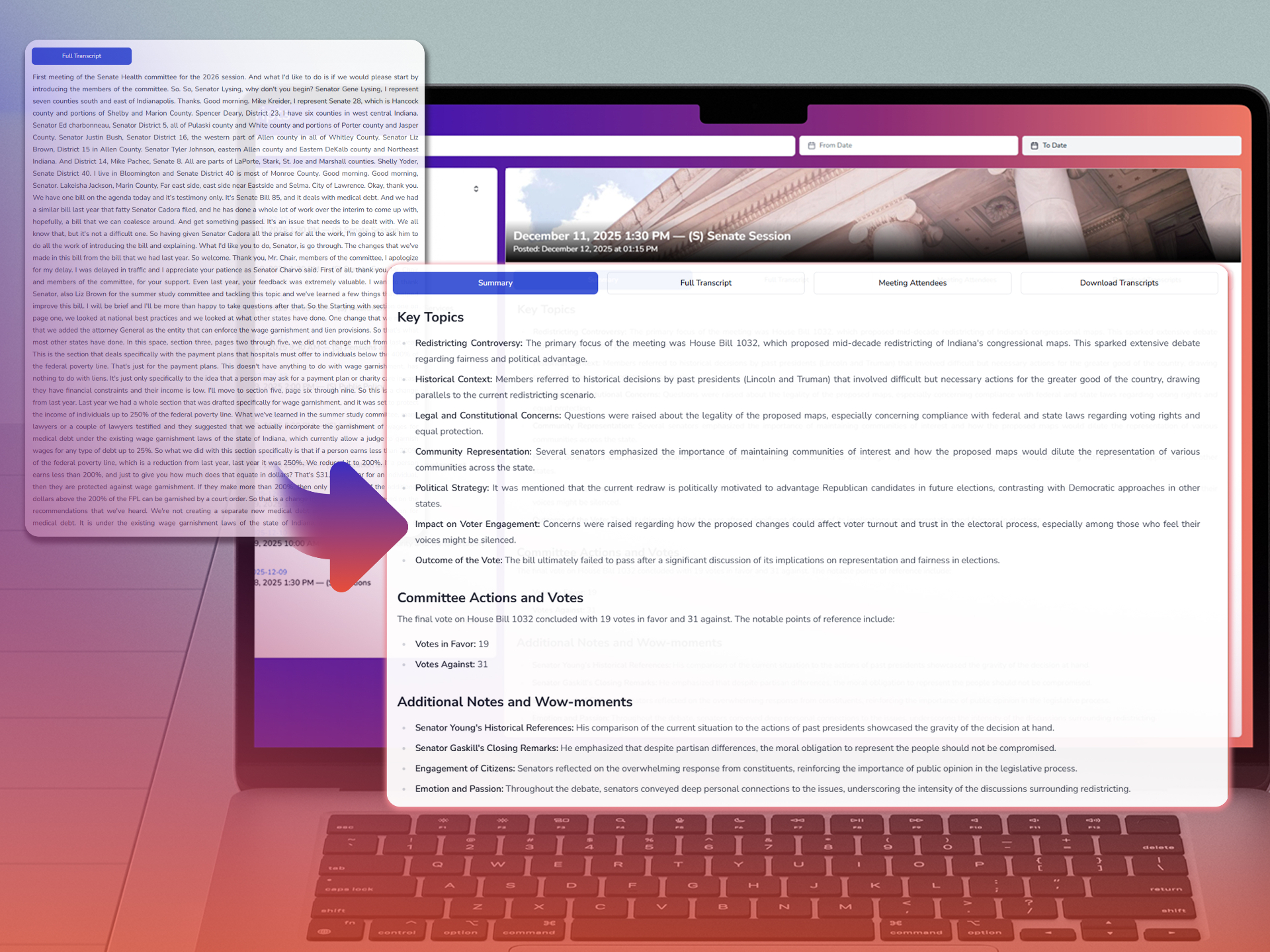
- Virtual lobbyist that monitors hearings, summarizes, and answers questions
- Concept → Architecture → Implementation
You can’t be in every room, but you still need to know what happened.
Lobbyists, GR teams, associations, and policy staff have a simple but brutal reality:
Multiple committees meet at the same time
Hearings are long, but only certain segments matter
Amendments and floor actions can drop with very little warning
Before Lobbyist AI, staying on top meant:
- Sitting through hours of live streams
- Replaying archived video to catch something you missed
- Hunting through bill pages, agendas, and scattered PDFs
- Piecing together secondhand summaries from news or email threads
The impact:
Time drain
Highly skilled staff spend hours just collecting information.
Coverage gaps
It's impossible to watch everything, so important moments can be missed.
Slow response
By the time someone understands what happened, the process has already moved to the next step.
Fourth Branch wanted a way for users to feel like they had a full-time lobbyist in every meeting—without adding headcount.
Design the AI layer: bots in every hearing + a chatbot that knows the Capitol.
Architect AI agents to "sit in" every legislative hearing and committee meeting by tapping into live streams and official audio
Build a transcription and summarization pipeline to turn hours of speech into clear, scannable notes
Create a notification system so users get timely alerts when something relevant happens
Build a custom Lobbyist AI LLM inside Fourth Branch so users can chat with an AI assistant
Example questions users can ask:
“What happened in the Senate Education Committee yesterday?”
“What's the current status of HB 1032?”
“Show me everything related to property tax caps this session.”
Our role was end-to-end: from product concept and data architecture to the actual pipelines and in-app chat experience.
A complete AI system for legislative intelligence
Situation
The raw ingredients were already out there: live and archived video, official bill texts, amendments, calendars. But all of it was hard to search, too time-consuming to watch, and disconnected from how GR professionals actually work.
Task
Build an AI system that automatically monitors meetings, transcribes and summarizes what happens, notifies users when relevant things occur, and exposes it all through a chat-based LLM.
Action
We designed Lobbyist AI as a chain of specialized components that feel like one unified assistant—a research assistant and meeting note-taker wrapped into one.
AI Agents That "Sit In" Every Meeting
For each relevant committee hearing or session, Fourth Branch's agents connect to the live stream at the scheduled time and capture the audio feed continuously.
- That audio becomes the input to the transcription and summarization pipeline.
- From the user's perspective, Lobbyist AI is "at" every meeting, whether they attend or not.
Real-Time Transcription & Structured Notes
Audio is processed through a speech-to-text model tuned for legislative environments (names, acronyms, procedural language).
- Transcripts are time-stamped and tied to: Committee, Date and time, Bills under discussion.
- This produces a searchable, structured transcript library instead of a pile of video links.
AI Summaries and Key Highlights
On top of the raw transcript, Lobbyist AI breaks hearings into logical segments and generates natural-language summaries.
- Segments include: opening, testimony, Q&A, debate, vote.
- Summaries capture: main topics, key arguments, notable amendments, outcomes.
- This turns "3 hours of committee video" into "3–5 minutes of reading."
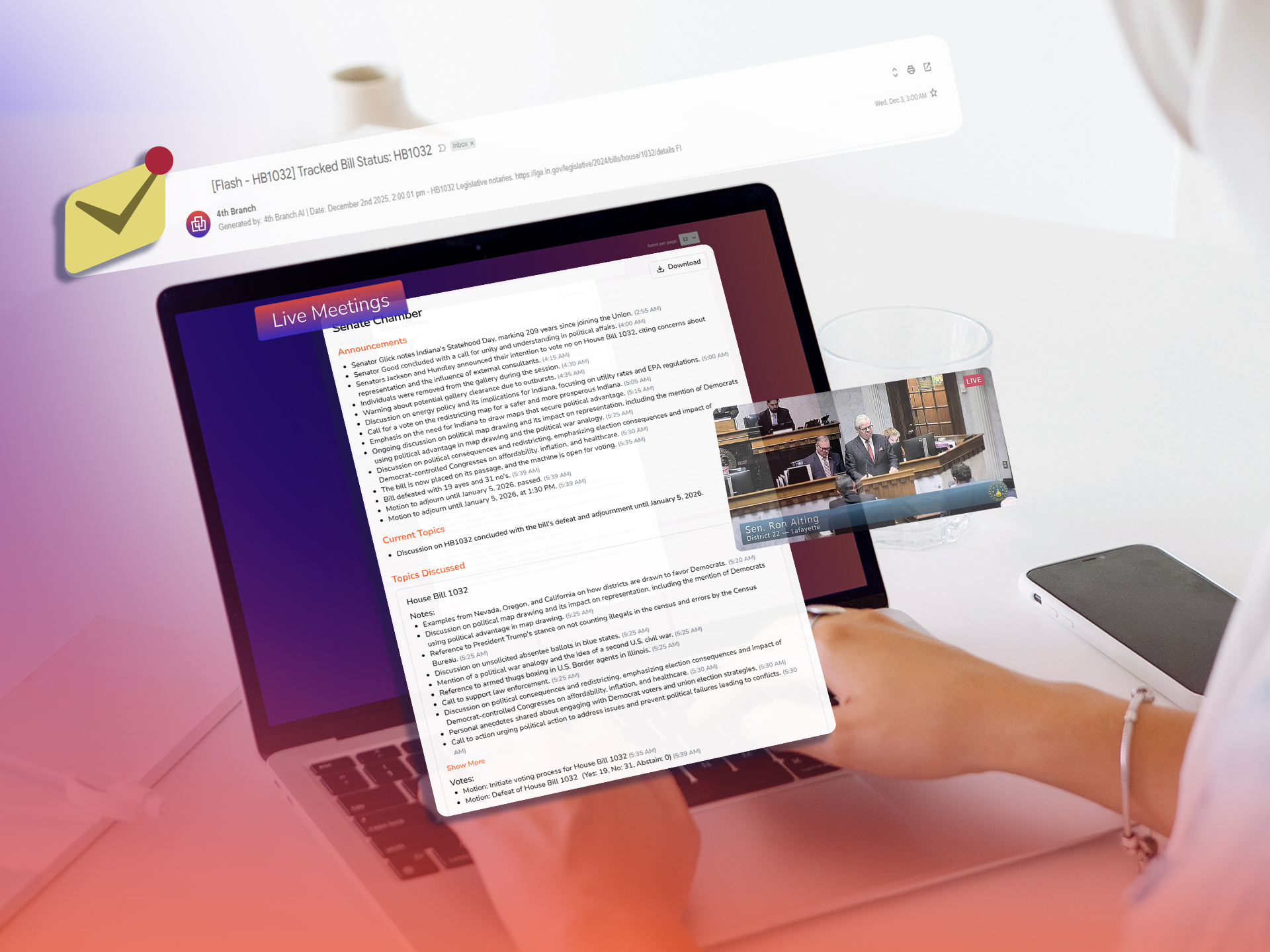
Notifications & Alerts
To keep users proactive rather than reactive, we helped design a notification layer.
- Users can track: specific bills, committees, topics or keywords.
- Lobbyist AI watches incoming transcripts and summaries for those signals.
- When something relevant appears, users receive in-app alerts and optional email digests.
Lobbyist AI LLM – Chat With the Legislature
The centerpiece is the Lobbyist AI LLM embedded directly into Fourth Branch.
- Users can open a chat and ask questions in plain English.
- The LLM searches across hearings, summaries, transcripts, bills, and actions.
- Responses include short summaries, linked references, and suggestions for follow-up.
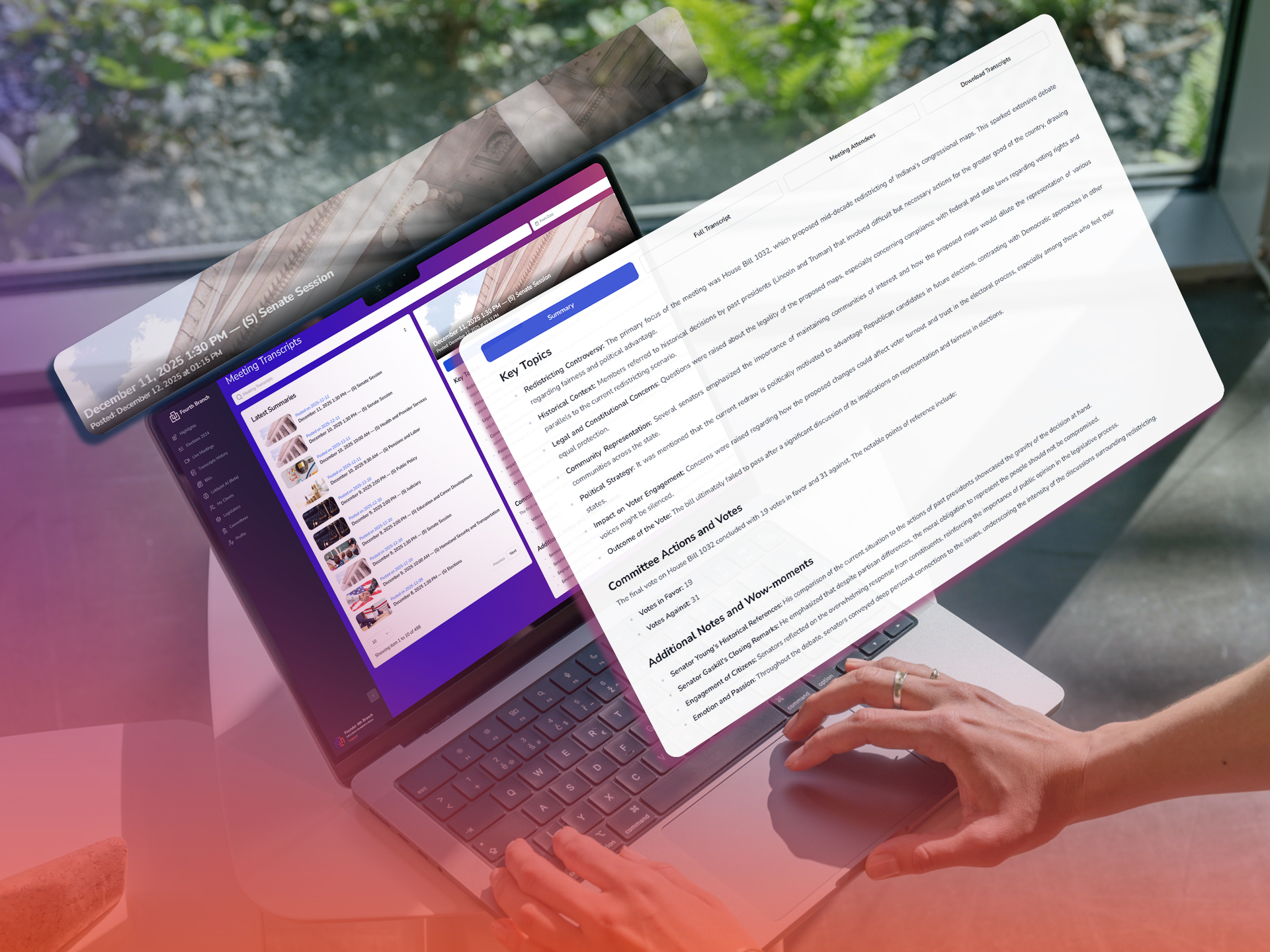
Hours of committee video become a few minutes of reading. Transcripts are time-stamped, tied to bills and committees, and summarized into segments users can scan—opening, testimony, Q&A, debate, and vote.
High-level architecture
Ingestion Layer
Connects to live streams, legislative data feeds, and document sources
Processing Layer
Audio → Transcript → Summaries, tagged entities (bill numbers, committees, topics)
Storage & Indexing
Structured storage of transcripts, summaries, and bill metadata; vector search for LLM retrieval
LLM & Agent Layer
Domain-focused LLM (Lobbyist AI) with retrieval over legislative data; guardrails for grounded answers
Application Layer
Meeting summaries UI, alerts & notifications, chat interface for Lobbyist AI
User Experience Highlights
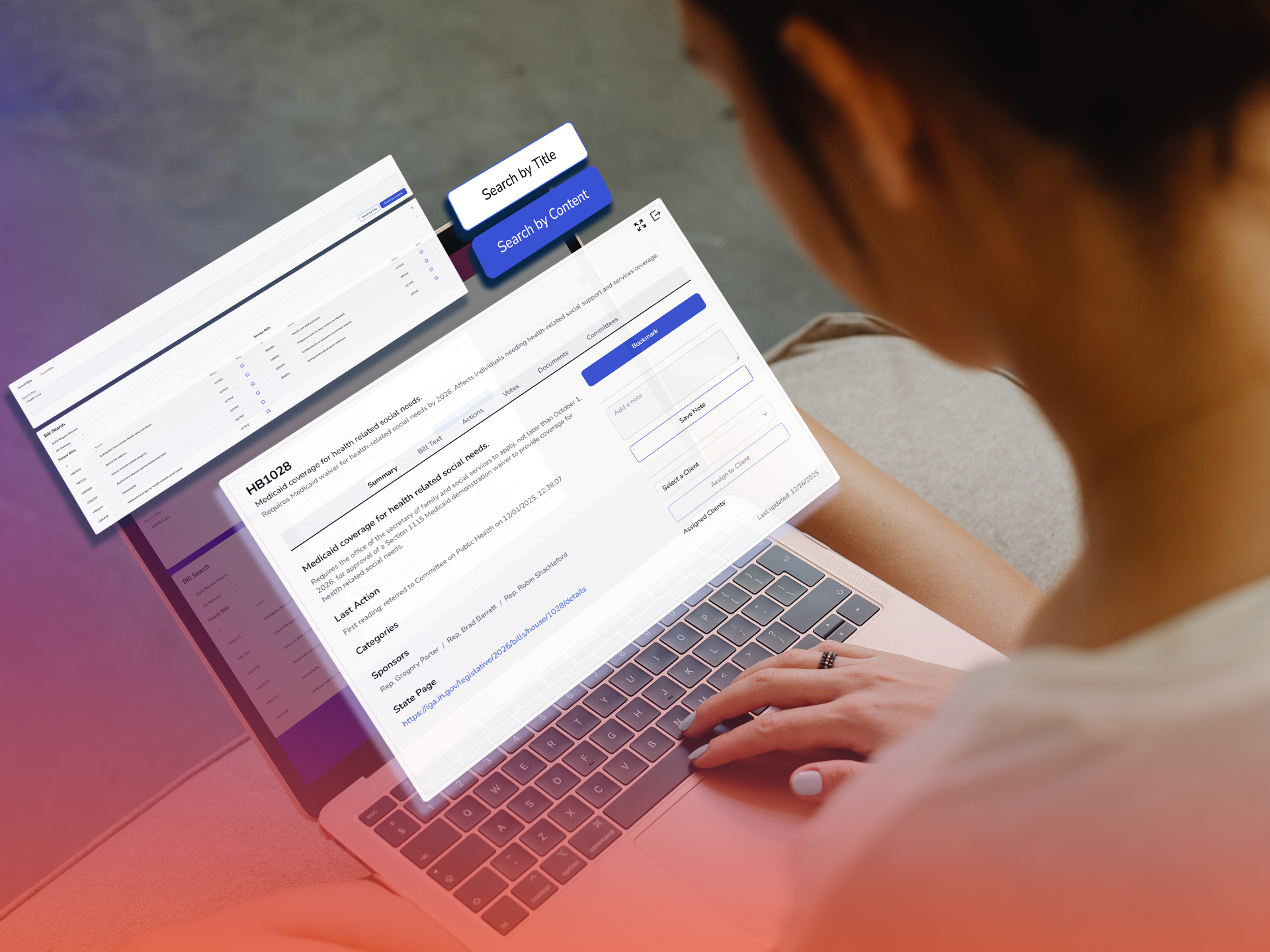
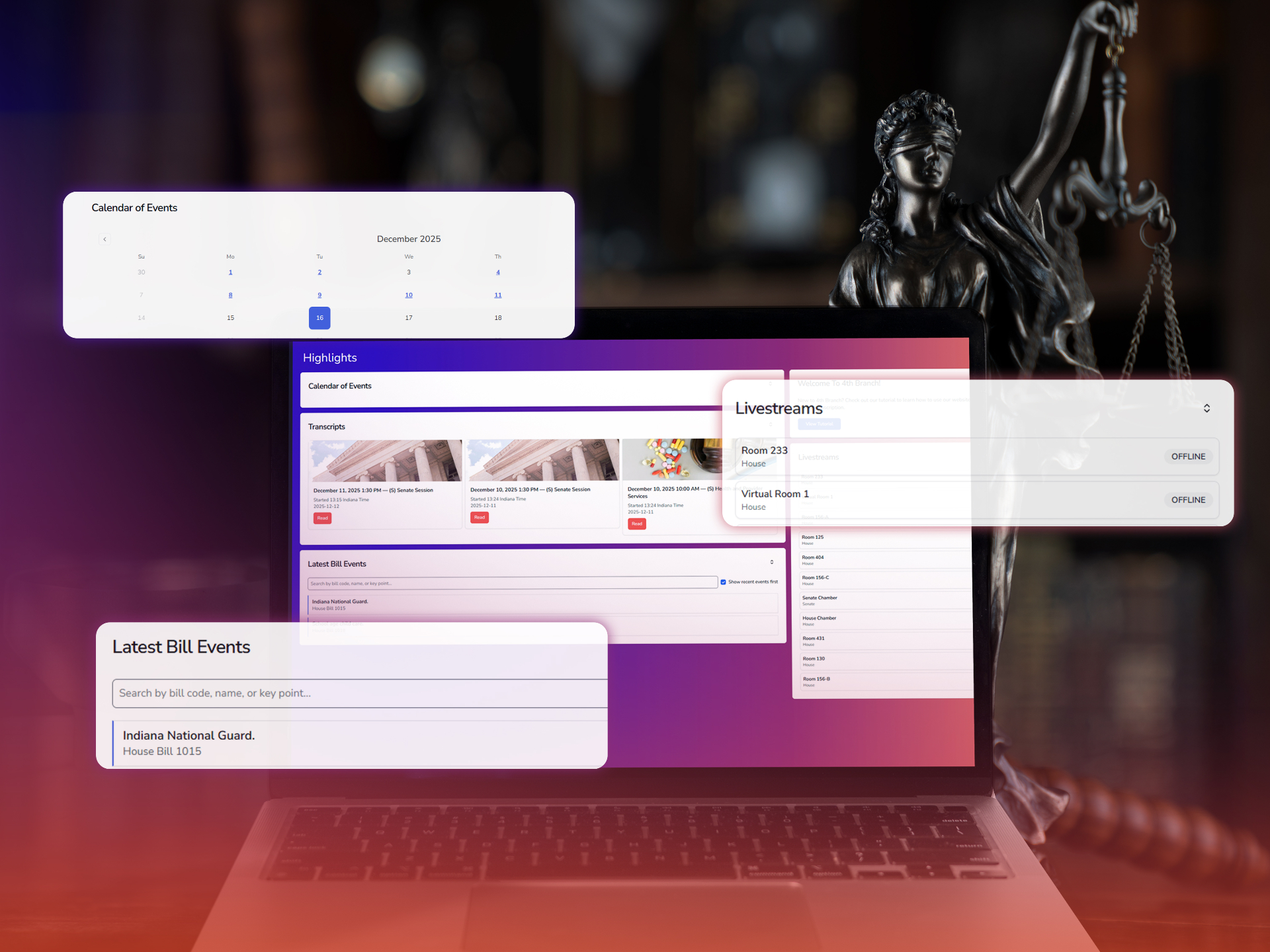
Meeting Summaries Page
Filter by committee, date, or bill, then dive into summaries or full transcripts.
Notification Center
Clear list of relevant updates triggered by the user's interests.
Chat with Lobbyist AI
Single interface where users can "ask the building" what happened—without hunting across multiple sites.
Results that matter
Some of the impact shows up in time savings; some in coverage and confidence:
Hours reclaimed per user per week
Staff no longer need to watch full hearings unless they choose to; summaries and Q&A handle the bulk of the work.
Greater coverage with the same team
One person can effectively track more committees and topics because AI is doing the first pass.
Faster responses to change
Alerts and summaries let teams react while issues are still in motion, not after the session is over.
Better institutional memory
The combination of transcripts, summaries, and chat gives teams a searchable history of "who said what when."
More than a gadget
For legislative professionals, Lobbyist AI feels less like a gadget and more like:
A junior lobbyist
who never sleeps, sits in every hearing, and takes detailed notes.
A research assistant
who can quickly answer, "What's the story on this bill?" or "Did anything happen on this topic today?"
A knowledge layer
that keeps the whole team aligned, even when they're in different rooms—or out of the building entirely.
It doesn’t replace expertise or strategy. It gives those experts back their time and attention.
From “We might miss something” to “We have an AI in every room.”
Before Lobbyist AI:
Tracking the legislature meant constant live streams, replays, and scrambling for updates. Critical context was locked inside video, PDFs, and individual inboxes.
With Lobbyist AI inside Fourth Branch:
- AI agents attend hearings, generate transcripts, and create summaries automatically.
- Users get notified when something relevant happens.
- A custom LLM lets them chat with their own legislative knowledge base.
Want to build your own AI-powered product?
Lobbyist AI is a live example of what happens when you combine a specific domain, a real ongoing data stream, and a custom LLM designed to sit on top of it all. If you're thinking about an AI assistant that watches your meetings, surfaces insights, or answers questions over your organization's data, Astra can help.